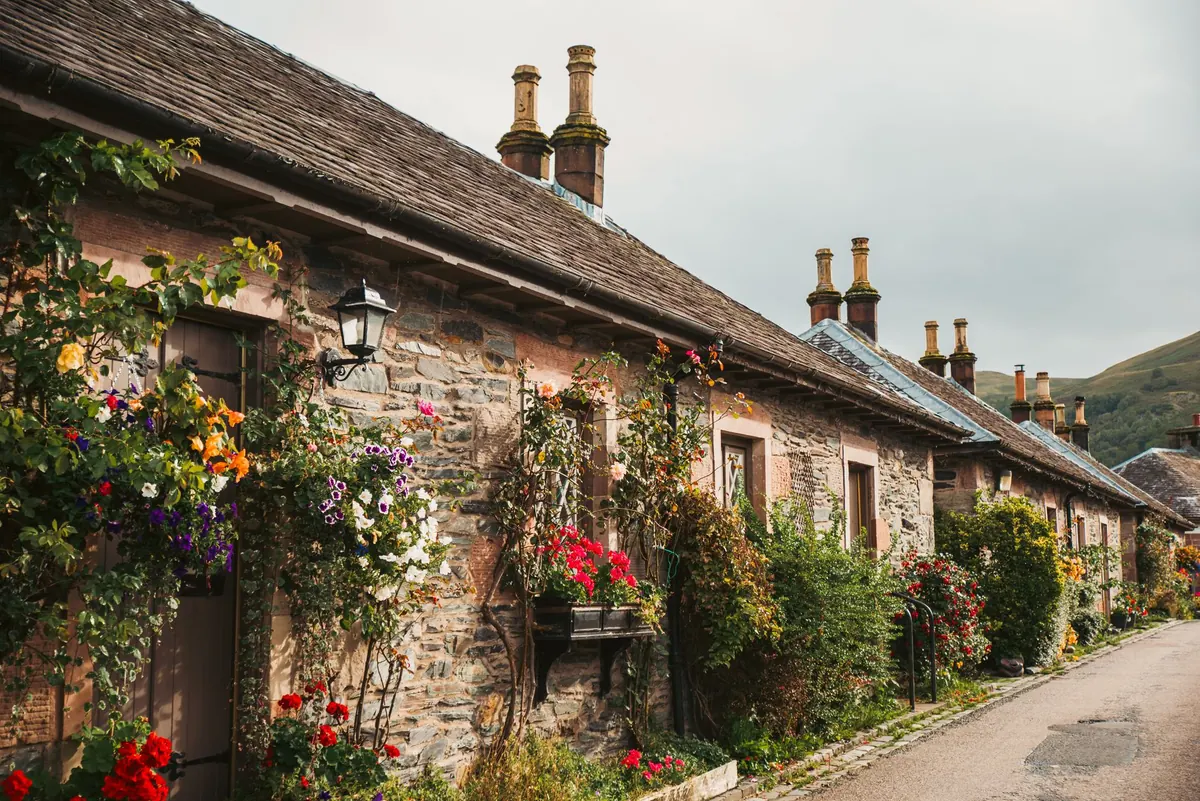
Stand in front of the same terrace at noon and again an hour before sunset and you would swear the stone had been cleaned, or repainted, or swapped for something warmer. Nothing about the wall has changed. The light has. Cotswold limestone is a quiet, pale, slightly grey material for most of the day, and then for roughly an hour it glows. Knowing why that happens makes it much easier to predict, catch and repeat.
What the stone is actually doing
Cotswold limestone is oolitic, laid down in warm, shallow seas during the Jurassic period. The rock is made largely of tiny concentric grains of calcium carbonate, and those grains give the surface a faintly sugary, granular texture. Iron oxides in the stone supply the cream, ochre and honey tones, while weathering softens the edges of the blocks and gives lichen and moss somewhere to hold on.
Three of those properties matter when you put a camera in front of them. The stone is light in tone, so it reflects a great deal of whatever light reaches it. It is warm in hue, so warm light pushes it further still. And it is uneven at the scale of a few millimetres, which means it responds dramatically to the angle the light arrives from.
Why low sun changes the colour
Light from a low sun travels through far more atmosphere to reach a village street than light from a noon sun. Shorter blue wavelengths are scattered away along that longer path, and what arrives is warmer and redder. Midday sun sits somewhere around 5500K; an hour before sunset it can be nearer 3000–4000K. Cotswold stone, already honey, gets pushed towards apricot and amber.
There is a second effect that is easy to overlook. Low sun is dimmer relative to the sky, and the sky above a sunset is still cool. That contrast does a lot of the work. The same wall against a steel-blue evening sky reads far warmer than it does against a pale, bright midday sky, because your eye is judging the wall against its surroundings rather than in isolation.
The Cotswolds are not honey-coloured. They are grey limestone for most of the day, and honey for about an hour of it.
Raking light, texture and the dry-stone wall
When sunlight arrives almost parallel to a wall, every small piece of relief casts its own micro-shadow. Mortar joints become visible lines. Weathered block edges, chipped quoins, the rough face of a field wall — all of it suddenly has depth instead of flatness. Midday light falls from above and fills those crevices, which is why a wall can look almost blank at two in the afternoon and full of detail at eight in the evening.
Dry-stone walls are the clearest demonstration. In raking light, each stone gets a lit face and a shadowed side, and the whole run becomes legible as a structure rather than a texture. Get close with a short telephoto or a normal lens, work at around f/8, and shoot along the wall rather than square-on so the shadows run across the frame instead of sitting flat.
Long shadows also become compositional tools. In a village street they lay diagonals across the road, cut a cottage into a lit half and an unlit half, and give you shapes to build a picture around rather than just a subject to point at.
Direction matters more than the clock
The single most useful thing you can learn about a Cotswold village is which way its prettiest facades point. A west-facing terrace catches the last light of the day; an east-facing one gets the first. The same row photographed at 7am and at 8pm is effectively two different buildings.
Reading a village before you arrive
Look at a map or satellite view before you go. Find the main street or the famous row of cottages and work out its alignment. If it runs roughly north to south, its western face is the evening face. If it runs east to west, one end of the street will light up before the other, and you can position yourself accordingly instead of wandering.
Midday is not useless — it is just honest. Front-lit walls, blue sky, short shadows, good for record shots and for showing a whole street cleanly. North-facing walls rarely receive direct sun at all, and stay cool, even and blue-grey; that makes them useful as contrast against a glowing wall on the opposite side of the street, and good for doorways, lichen and detail.
One seasonal note worth remembering: in December the sun barely climbs, so the low, warm light lasts much of the day rather than an hour. The trade-off is that some days it never breaks through the cloud at all.
Weather, wet stone and broken cloud
Rain changes limestone more than any filter will. Wet stone darkens noticeably in tone and saturates, so the honey turns closer to caramel and paving slabs start to reflect. Sunshine breaking through twenty minutes after a shower gives you the richest version of a Cotswold street, with a lit wall, a dark wet road and steam or mist rising off the rooftops.
Flat overcast does the opposite: even, low-contrast, slightly cool light that erases raking shadows and turns the stone grey. It is workable for architectural detail, but it will not give you the colour you came for. Broken cloud is the interesting middle ground — the light changes every twenty seconds, so pick a corner where two or three good facades are visible and wait for the sun to land on the one you want.
Camera habits that help
- Shoot raw and set white balance manually. Daylight (around 5500K) keeps the warmth you came for. Auto white balance will dutifully neutralise the honey.
- Expose for the lit stone, not the sky. A little clipped sky is usually fine; blown-out stone loses the colour that is the entire point.
- Bracket. A sunlit wall against a shaded lane often exceeds what one frame can hold.
- Work around f/8 to f/11 for texture and depth. Stop down further only if you actually need it.
- Use a polariser with care. It cuts glare from wet stone and deepens sky, but it can also strip out the warm bounce light that makes golden hour worth waiting for. Rotate, look, decide.
- Carry both a wide and a short telephoto. Wide for street and sky, telephoto to compress rooftops and chimneys into a stack of warm shapes.
- Wait for a person. A figure walking through the lit half of the frame gives scale and a reason to look twice.
A practical golden-hour plan
- Check sunset time, then arrive around 75 minutes before it. The first half hour is warm but still bright enough to handhold.
- Walk the whole village first while the light is even. Note which walls are already catching sun and which will catch it later.
- Shoot your wide street compositions early, then move in close for wall texture and doorways as the light drops.
- In the last twenty minutes, turn into the sun. Shoot rim-lit walls, long shadows across the road, and backlit figures.
- Stay for blue hour, roughly 20–30 minutes after sunset. Stone goes lavender-grey, windows come on, and the village reads completely differently again.
- Keep notes on which facades worked at which time. Next visit, you start where you finished.
Golden hour in the Cotswolds is generous but short, and it rewards planning more than luck. Pick your village for the direction its best wall faces, get there early, and let the stone do what it does for that one hour a day.
Photo: Zoe Jackson / Pexels